News
GEAR Tool for Gender Equality Plans in academia and research organisations.
EIGE, the European Institute for Gender Equality and the European Commission have…
New GENDER-NET ERA-NET reports now available !
The new GENDER-NET reports are now available online and can be downloaded here: …
Events
Project meetings
EU-conferences
28.11.2017 – 29.11.2017
Final Conference TRIGGER
Maxime Forest Guest speaker, presentation on EGERA GEPs, instruments and challenges…
National conferences
27.09.2017 – 28.09.2017
Arbeitstagung der „Konferenz der Einrichtungen für Frauen- und Geschlechterstudien im deutschsprachigen Raum (KEG)"
Die nächste Arbeitstagung der „Konferenz der Einrichtungen für Frauen- und…
28.09.2017 – 30.09.2017
Tagung „Aktuelle Herausforderungen der Geschlechterforschung“
Im September 2017 findet an der Universität zu Köln in Kooperation mit GeStiK unter…
"Group Model Building" at University of Vechta, Germany
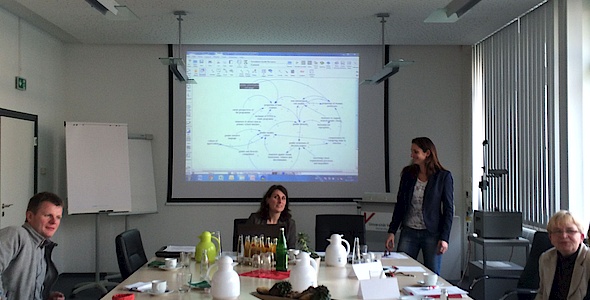
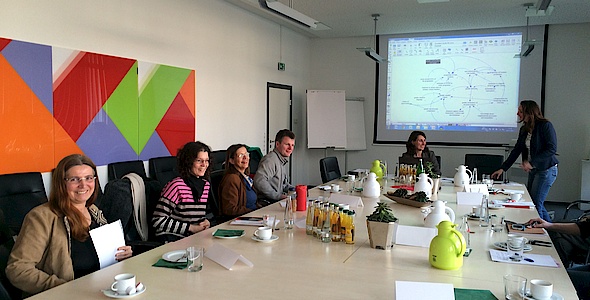
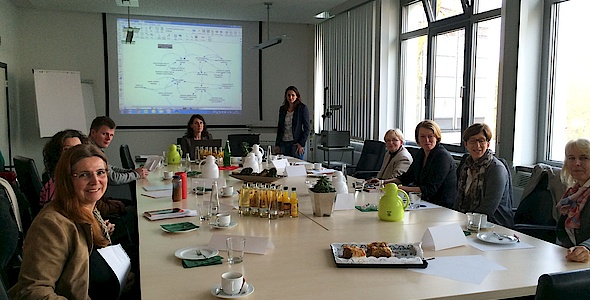
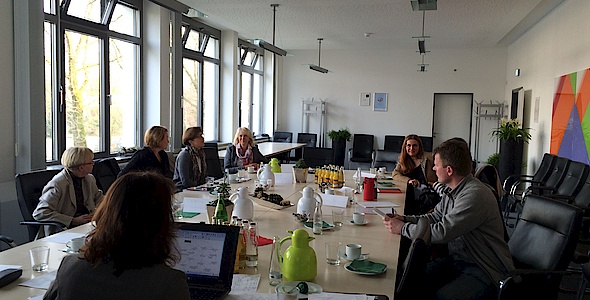
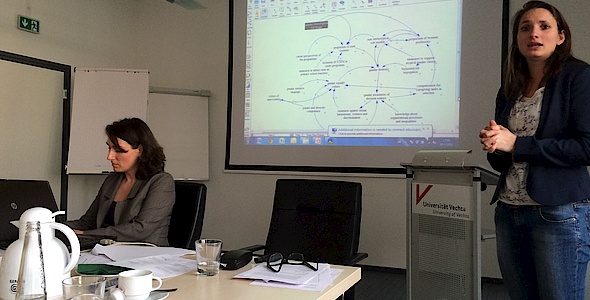
Group Model Building in Vechta
The first session of the management training "group model building" took place at the 18th of March 2015 at University of Vechta. It was facilitated by Inge Bleijenbergh and Pleun van Arensbergen from Radboud University, Nijmengen (EGERA WP 4 leader). Group Model Building (GMB) is a method to give a management team, a team of stakeholders, or a group of professionals insights in the different causes of an organizational problem and the possible solutions. GMB is based on system dynamics and helps people to envision a problem situation in a systemic way. In a few sessions, individual mental models are integrated when the group builds, with the help of a facilitator, a causal loop diagram to come to a better understanding of the problem. The model visualizes the interaction of causes and effects of the problem through feedback processes. Taking part in the building of the model also creates a basis for change. This method integrates the knowledge and experience of participants, facilitates the discussion between managers, personnel and gender experts and thus helps to reconcile different insights. The model helps to identify concrete opportunities for interventions (leverages for change). GMB will be systematically applied with the project partners in the EU FP7 EGERA project to train management teams in research and academia.
Submitted by egera-admin on 23.03.2015 – 11:15 am